Flash USDT Creation Using New Method Explained
· based on the channel Rca FastPrint
Flash USDT is a newly introduced method for generating USDT-like tokens quickly on the Ethereum blockchain using smart contracts. This approach leverages development environments such as ChainIDE and wallet interfaces like MetaMask to create, test, and interact with Flash USDT tokens securely and efficiently. The complete workflow involves coding the smart contract, deploying it, and managing the token through wallet software.
## Understanding Flash USDT and Its Concept
Flash USDT refers to a flash-created USDT token variant implemented as an ERC20 smart contract on the Ethereum blockchain. Unlike official USDT tokens issued by Tether, Flash USDT is a custom token that can be generated by developers for testing, educational, or development purposes. The method involves writing Solidity code that mirrors the USDT ERC20 token structure, enabling rapid token creation and deployment.
## Setting Up ChainIDE for Flash USDT Development
ChainIDE is an online integrated development environment optimized for blockchain and smart contract projects. To create Flash USDT, developers start by opening ChainIDE and importing or writing the Flash USDT smart contract script. This environment supports Solidity programming, compilation, and deployment steps, making it accessible for developers to build ERC20 tokens without local installations.
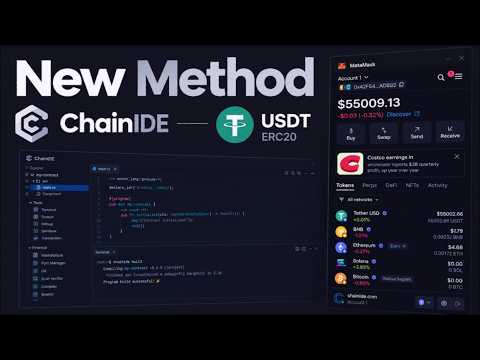
Video: How to Create Flash USDT With New Method 2026
Once the script is loaded, ChainIDE provides tools to compile the contract, check for errors, and deploy it to Ethereum test networks or local blockchains. The platform's interface facilitates debugging and contract interaction, essential steps before connecting the token to wallet software.
## The ERC20 Token Structure Behind Flash USDT
The Flash USDT token follows the ERC20 standard, which defines a common interface for fungible tokens on Ethereum. The contract includes essential functions such as `totalSupply`, `balanceOf`, `transfer`, `approve`, and `transferFrom`. These functions ensure token holders can send, receive, and authorize transactions securely.
The contract also defines metadata like token name, symbol (usually "FlashUSDT"), and decimals (commonly 6 or 18). Implementing these features carefully ensures the Flash USDT token behaves consistently within the Ethereum ecosystem.
## Connecting MetaMask to Manage Flash USDT Tokens
MetaMask is a popular Ethereum wallet that allows users to store and interact with ERC20 tokens. After deploying the Flash USDT contract via ChainIDE, users add the token contract address to MetaMask to visualize and manage their Flash USDT balance.
Steps to connect MetaMask include:
1. Open MetaMask and select the appropriate Ethereum test or main network.
2. Use the "Add Token" feature and input the Flash USDT contract address.
3. MetaMask fetches token details automatically or requires manual input.
4. Users can now send and receive Flash USDT tokens through the wallet interface.
This integration is crucial for real-time token management and interaction with decentralized applications (dApps).
## Testing and Verifying Flash USDT Deployment
Before using Flash USDT with real funds or on mainnet, thorough testing on Ethereum testnets (such as Ropsten, Rinkeby, or Goerli) is vital. Testing steps include:
- Deploying the contract on a testnet through ChainIDE.
- Interacting with the contract functions to verify token transfers and approvals.
- Confirming token balances update correctly in MetaMask.
- Checking for common errors such as insufficient gas, wrong network selection, or incorrect contract addresses.
Verification ensures the contract behaves as expected and prevents loss of assets due to faulty code or misconfigurations.
## Common Mistakes and Best Practices
Several pitfalls can arise during Flash USDT creation:
- Sending real funds to unverified contracts can result in permanent loss.
- Not reviewing smart contract source code independently may expose users to vulnerabilities.
- Forgetting to switch MetaMask to the correct network can cause transaction failures.
- Overlooking gas limit settings can stall contract deployment or token transfers.
Best practices include:
- Always test on testnets before mainnet deployment.
- Verify contract addresses and source code thoroughly.
- Use recommended tools like ChainIDE and MetaMask for development and management.
- Keep private keys secure and never share them.
## Useful Links
- Official Flash USDT creation script and guide: https://sites.google.com/view/defiflashusdt
## Conclusion
Creating Flash USDT tokens using the new method involves the integration of ChainIDE for smart contract development and MetaMask for wallet management. This approach provides a practical environment for developers and enthusiasts to experiment with ERC20 token creation safely and efficiently. Remember, this method is intended for educational and testing purposes; never send real funds to unknown contracts without proper verification. For a detailed step-by-step tutorial and ongoing updates, refer to the Flash USDT guide and the Rca FastPrint channel, which offers comprehensive insights into this innovative method.
Key takeaways
- Flash USDT is an ERC20 token created via smart contracts on Ethereum.
- The method uses ChainIDE for contract development and MetaMask for wallet interaction.
- Flash USDT creation requires careful setup of smart contracts and wallet connectivity.
- Testing and verification are crucial before using Flash USDT on main networks.
- The process is intended for educational and development purposes only.
Source: How to Create Flash USDT With New Method 2026 · Markdown version
Questions & answers
What is Flash USDT and how does it differ from regular USDT?
Flash USDT is a custom ERC20 token created via smart contracts for testing and educational purposes. Unlike official USDT issued by Tether, Flash USDT is developer-generated and not backed by Tether's reserves.
Which tools are essential for creating Flash USDT tokens?
ChainIDE, an online Solidity development environment, and MetaMask, an Ethereum wallet, are essential for coding, deploying, and managing Flash USDT tokens.
Can I use Flash USDT with real funds on the Ethereum mainnet?
Flash USDT is intended for development and testing only. Sending real funds to unverified Flash USDT contracts on the mainnet is risky and not recommended without thorough review.
How do I verify that my Flash USDT token contract works correctly?
Deploy the contract on Ethereum testnets, interact with functions like transfer and approve, check balances in MetaMask, and confirm no errors occur during transactions to ensure correct functionality.